Projects & Research
A selection of research and fieldwork projects focused on data analysis, community-based work, and real-world public health challenges.
Student Financial Literacy Study
Analyzed survey data from 700+ UC San Diego undergraduates to identify financial literacy gaps and inform campus-wide program development.
Humble Design Services Evaluation
Analyzed demographic survey data from 169 clients to support evaluation of a housing intervention for individuals transitioning out of homelessness.
Food Insecurity Photovoice Study
Led participant coordination and contributed to analysis in a qualitative study examining how UC San Diego students make food choices and experience food insecurity.
Coming Soon
Student Financial Literacy Study
Key Findings:
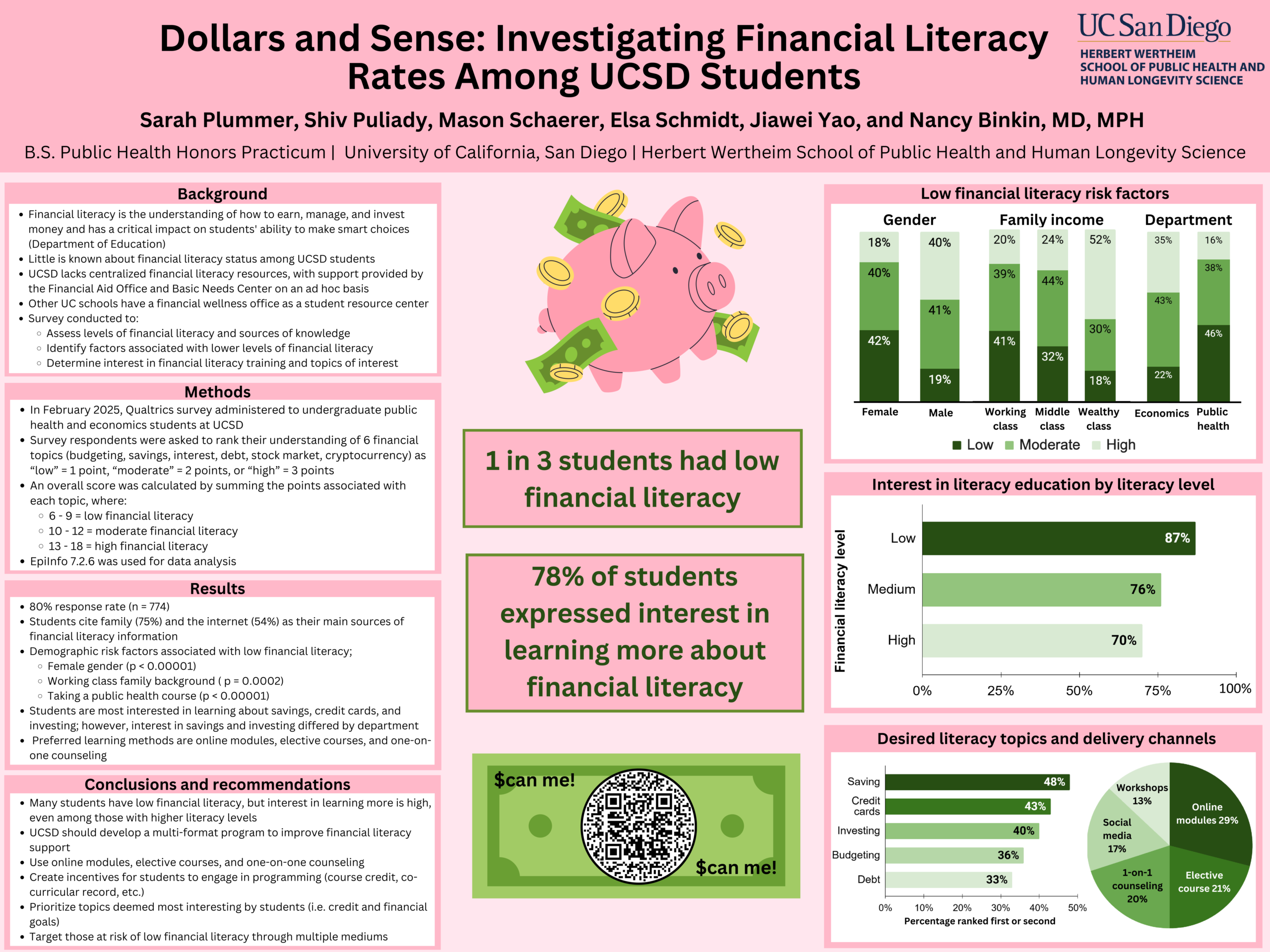
A large proportion of students demonstrated low to moderate financial literacy across core financial domains
Lower literacy levels were disproportionately observed among women, students from working-class backgrounds, and those receiving financial aid
Students enrolled in economics courses showed higher financial literacy levels, suggesting a link between academic exposure and financial knowledge
Strong interest in financial literacy education was observed across all groups, with the highest interest among those with lower baseline literacy
The most requested topics included financial goal-setting, credit management, and investing
Preferred formats included online modules, elective coursework, and individualized counseling
Project Summary:
As part of a public health practicum, our team conducted a large-scale study to assess financial literacy among UC San Diego undergraduates and identify factors associated with lower levels of financial knowledge. The project was developed in collaboration with campus stakeholders, including financial aid leadership and university financial analysts, with the goal of informing future financial literacy programming.
I played a central role in data preparation and analysis, working with survey data from over 700 undergraduate students. This included recoding variables, constructing composite measures of financial literacy, and conducting bivariate statistical analyses using Epi Info to identify relationships between demographic, academic, and financial factors.
Later in the project, I independently integrated an additional dataset of over 200 upper-division economics students, refining coding structures and extending the analysis to compare literacy levels across academic disciplines.
Our findings were presented to university stakeholders and shared through conference poster sessions.
These results contributed to ongoing discussions around expanding financial literacy resources and programming at UC San Diego.
Methods:
Analyzed cross-sectional survey data collected via Qualtrics from 700+ undergraduate students
Constructed a composite financial literacy index across domains including budgeting, savings, debt, investing, and cryptocurrency
Recoded and dichotomized variables to enable subgroup comparisons
Conducted bivariate statistical analysis using Epi Info to assess relationships between literacy levels and demographic/academic factors
Evaluated subgroup differences to identify populations at elevated risk
Integrated and standardized an additional dataset of upper-division economics students for comparative analysis
My Role:
Led data cleaning and variable recoding to prepare datasets for analysis
Developed composite measures of financial literacy across multiple survey domains
Conducted statistical analysis to identify key risk factors and group differences
Independently integrated and analyzed an additional dataset, extending the scope of the project
Presented findings to university stakeholders and participated in conference poster sessions
Food Insecurity Photovoice Study
Key Findings:
Taste and convenience were the most frequently cited factors influencing meal selection, often outweighing cost
Students commonly considered multiple factors simultaneously, especially combinations of taste, convenience, and price
A high frequency of skipped meals was observed, with breakfast being the most commonly missed
No clear relationship was found between dining plan type and daily spending patterns
Limited consumption of fruits and vegetables was observed across both self-prepared and purchased meals
Some students experiencing financial constraints did not utilize available campus food resources, suggesting gaps in awareness or accessibility.
Project Summary:
Following a prior study identifying high rates of food insecurity among UC San Diego undergraduates, our team conducted a qualitative photovoice study to better understand how students make decisions about their meals. The project was developed in collaboration with campus dining leadership to explore the roles of cost, convenience, nutrition, and social factors in food choice.
We designed and administered a two-day photovoice survey using Qualtrics, where 17 undergraduate participants documented their meals through photos and written reflections. This approach captured not only what students were eating, but the reasoning behind their choices in real time.
I led participant coordination and retention, maintaining consistent engagement throughout the study and ensuring complete data collection. I also contributed to qualitative coding of over 100 responses, organizing themes such as taste, convenience, price, and nutritional value into structured categories, and translating these into simplified summaries for stakeholder communication.
In addition, I conducted exploratory bivariate analysis to examine patterns in spending behaviors, dining plan usage, and meal-skipping.
These insights were presented to campus dining stakeholders to inform discussions around accessibility, student behavior, and support services.
Methods:
Designed and administered a two-day photovoice survey using Qualtrics
Recruited undergraduate participants with active campus dining plans
Collected participant-generated data including meal photos, cost estimates, and written reflections
Conducted qualitative thematic coding to identify key factors influencing food decisions
Translated qualitative findings into structured summaries and simple quantitative representations
Performed exploratory bivariate analysis on spending patterns, dining plan usage, and meal-skipping
My Role:
Led participant coordination and retention, ensuring consistent survey completion
Served as the primary liaison with campus dining stakeholders
Contributed to study design and survey development
Conducted qualitative coding and thematic analysis
Performed exploratory data analysis on behavioral patterns
Co-developed and delivered presentations to stakeholders
Humble Design Services Evaluation
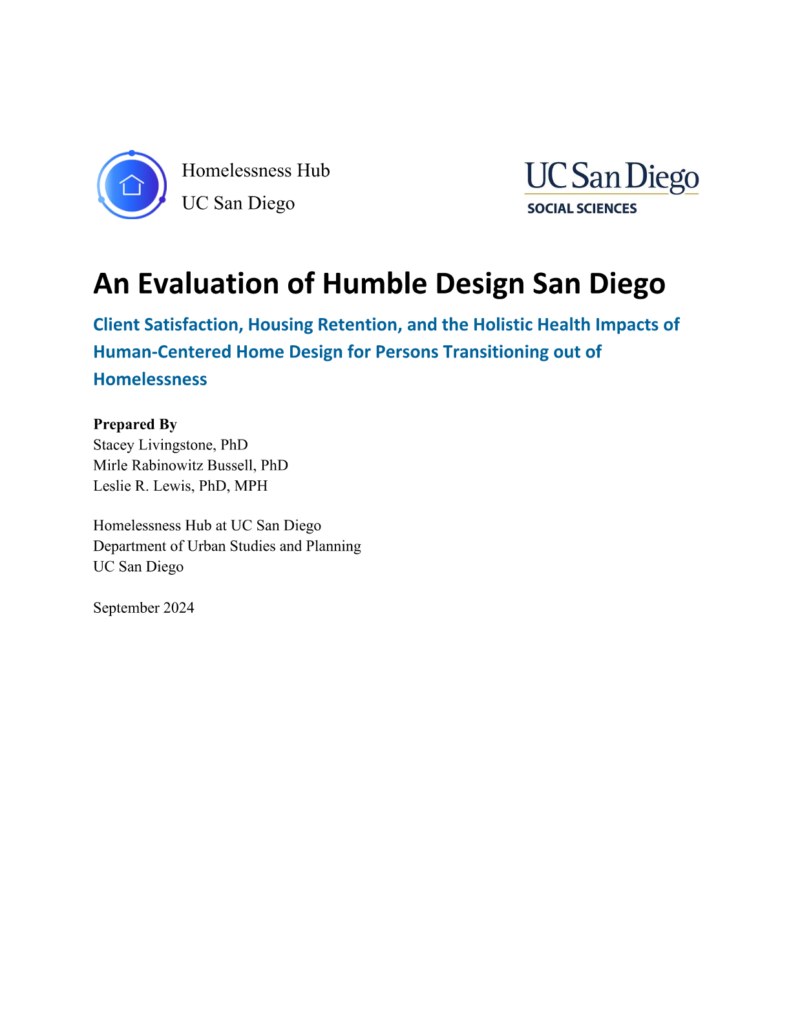
As part of a collaborative research effort between the Homelessness Hub at UC San Diego and Humble Design San Diego, I contributed to the evaluation of a human-centered housing intervention supporting individuals and families transitioning out of homelessness. The study examined how interior design and furnishing services influence client satisfaction, health, wellbeing, and housing stability.
I was responsible for analyzing demographic survey data from 169 Humble Design clients, developing summary tables and descriptive statistics across key variables. I translated these findings into clear written summaries used in a larger research report, contributing to a broader mixed-methods study that also included in-depth interviews and qualitative analysis.
I presented my findings to the Humble Design Board of Directors as part of a group presentation. The final report, published through the UC San Diego Homelessness Hub, integrates these results to better understand how environmental factors influence the transition from housing to a sense of home.
This work supported ongoing efforts to evaluate and improve programs designed to promote long-term housing stability and wellbeing.